
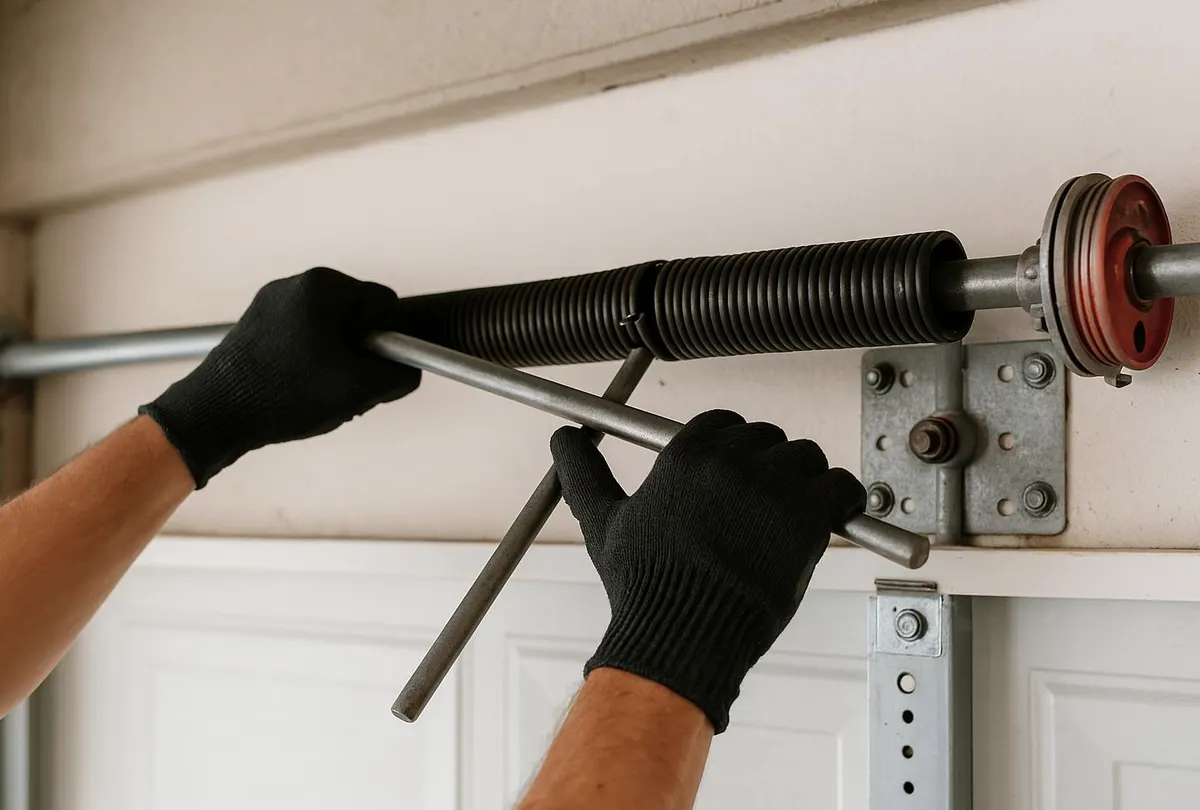
What a Spring Failure Actually Costs You
A garage door spring rarely gives much warning before it goes. One day it's lifting the door like normal, the next it's a loud bang and a door that won't budge, or worse, a door that slams shut with no resistance at all. Put that off for one more season and you're betting against hurricane season, which in this part of Florida doesn't really wrap up until late November. A failed spring at the wrong moment means a car trapped inside (or outside) right when you need to move it ahead of a storm, a door you can't seal against wind and rain, and an emergency repair call that costs more than a planned one because nobody wants to negotiate pricing at 9pm in a downpour.
The good news is that springs almost always show signs of wear before they break. You just have to know where to look and what you're looking at.
Torsion vs. Extension Springs: Quick Refresher
Torsion springs sit on a metal bar directly above the closed door, winding and unwinding as the door moves. Extension springs run along the horizontal tracks on either side of the door and stretch and contract instead. The checklist below covers warning signs for both, since homes in Layton, Islamorada, and across the Keys have a mix of both systems depending on the age of the house and when the door was last replaced.
The Walk-Through Checklist
1. Look at the coil spacing on a torsion spring
With the door closed, look at the spring (or springs) mounted above the door. The coils should be evenly spaced along the whole length. If you spot a gap where the coils are bunched tighter on one side and stretched wider on the other, that's a sign the spring is losing tension unevenly. Left alone, this usually ends in the spring separating at that weak point.
2. Check for rust or flaking metal
Salt air off the coast works fast on exposed metal, and spring steel is no exception. Surface rust that's just a light orange film is cosmetic for now, but flaking, pitting, or rust that's eaten into the coil itself weakens the metal's ability to flex under load. A spring with heavy pitting can fail at tension levels it used to handle without issue.
3. Look for stretched extension springs
On an extension spring system, compare the gap between coils when the door is closed. A spring that's been overworked will show coils pulled noticeably further apart than a healthy spring on the same door, sometimes with visible thinning at the stretch points. That stretching means the spring is losing its ability to snap back, and it's a direct precursor to a full break.
4. Watch the door's balance as it opens
Open and close the door a few times and watch the top edge. It should stay level the whole way. A door that tilts, dips on one side, or looks crooked partway through the cycle usually means one spring (in a two-spring torsion system) is carrying more load than the other, which accelerates failure on the weaker side.
5. Do the manual lift test
Disconnect the opener using the release cord (usually a red handle hanging from the track) and lift the door by hand about halfway. A properly tensioned spring should let the door feel nearly weightless and stay in place when you let go. If it feels heavy, drops on its own, or takes real effort to lift, the spring has already lost a significant amount of its working tension.
6. Pay attention to new noises
A single pop or bang the first time you notice it might be nothing. Regular creaking, grinding, or a metallic squeal every time the door cycles is different; it usually means the coils are rubbing somewhere they shouldn't be, often because the spring has started to warp or lose its shape.
7. Notice if the opener is working harder
If your garage door opener motor runs longer than it used to, strains audibly, or the chain/belt shows slack it didn't have before, the opener is compensating for a spring that's no longer doing its share of the lifting. That's extra wear on the opener on top of the spring problem.
8. Check for a loose or frayed cable at the bottom bracket
On extension spring systems especially, look at the cables running from the bottom corners of the door up to the spring assembly. Fraying, visible slack, or a cable that's come off its pulley often shows up alongside spring wear, since a failing spring puts uneven strain on the whole system.
Why This Matters More in Hurricane Season
Humidity swells wood and composite door panels, afternoon downpours keep moisture sitting on metal hardware longer than drier climates would, and salt air accelerates corrosion on springs faster than inland springs ever see. All of that shortens the realistic lifespan of a spring that might otherwise have another year or two left in it. If you're checking the list above and see two or more warning signs, don't wait for the storm season to test the door's limits for you.
When to Call Layton Garage Door Pro
If the manual lift test feels heavy, the coils look uneven, or you're seeing rust that's past the surface stage, that's the point to call in a technician rather than keep testing it yourself. Garage door springs are under serious tension and aren't a safe DIY repair. Layton Garage Door Pro's Garage Door Spring Repair service covers inspection, safe tension release, and replacement with hardware rated for Florida's humidity and salt exposure. If the spring still has some life left but the whole system is due for a check, our Garage Door Maintenance & Tune-Up service covers lubrication, balance testing, and a full hardware inspection before storm season puts it to the test.
If you've spotted any of these warning signs on your garage door in Layton, Islamorada, Marathon, or anywhere along the Keys, call Layton Garage Door Pro today and get it checked out before it becomes an emergency.